


Retort Processing of Flavoured Milk is gaining increasing attention as demand for shelf-stable dairy beverages grows worldwide, with consumers seeking convenient, ready-to-drink products that can be stored and distributed without refrigeration.
Retort processing offers an effective solution for manufacturing commercially sterile flavoured milk with extended shelf life at ambient temperatures. When properly designed and validated, a retort process can help manufacturers achieve product safety, maintain quality, and expand market reach without relying on a cold chain.
This article provides an overview of retort processing for flavoured milk, including process flow, equipment requirements, packaging considerations, and key technical challenges.
Key Characteristics of Retort-Processed Flavoured Milk
| Parameter | Description |
|---|---|
| Product Type | Flavoured Milk Beverage |
| Processing Method | Retort Sterilization |
| Package Type | Retortable PP Bottles, Glass Bottles, Retort Containers |
| Storage Condition | Ambient Temperature |
| Refrigeration Required | No (when properly processed and packaged) |
| Primary Objective | Commercial Sterility |
| Key Equipment | Homogenizer, Filling System, Retort |
| Critical Considerations | Product Stability, Container Integrity, Process Validation |
| Common Challenges | Fat Separation, Sedimentation, Flavour Changes, Bottle Deformation |
| Typical Applications | Dairy Beverages, Functional Drinks, Protein-Enriched Milk Products |
What is Retort-Processed Flavoured Milk?
Retort-processed flavoured milk is a dairy beverage that has been filled into heat-resistant containers, hermetically sealed, and subjected to thermal processing in a retort system to achieve commercial sterility.
Unlike pasteurized milk, which requires refrigerated storage, retort-processed flavoured milk can often be stored at ambient temperatures for extended periods when properly formulated, packaged, and processed.
Typical products include:
- Chocolate milk
- Coffee-flavoured milk
- Vanilla milk
- Strawberry milk
- Malt-based milk beverages
- Protein-enriched dairy drinks
Why Choose Retort Processing?
Retort processing offers several advantages for dairy beverage manufacturers:
Extended Shelf Life
Commercial sterilization significantly extends product shelf life compared to refrigerated products.
Reduced Dependence on Cold Chain
Products can be transported and stored without refrigeration, reducing logistics costs.
Wider Market Access
Shelf-stable products can reach remote regions and export markets where cold-chain infrastructure may be limited.
Convenience
Consumers benefit from ready-to-drink beverages that can be stored at room temperature.
Retort technology is widely used across multiple food categories, from dairy beverages to seafood meals. Explore a practical example in our article, Shelf-Stable Fish Curry and Prawn Masala: How Retort Meals Preserve Authentic Taste (https://potandladle.com/shelf-stable-fish-curry-prawn-masala-retort-meals/)
Retort Processing of Flavoured Milk – Manufacturing Process
A simplified process flow may include:
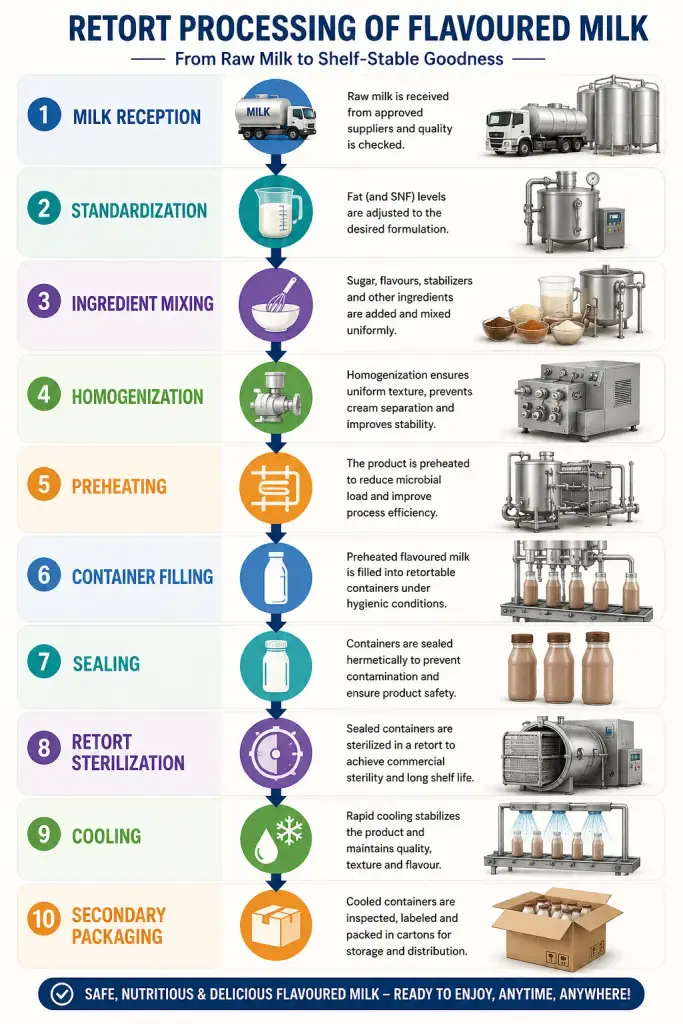
The exact process sequence may vary depending on product formulation, packaging format, and plant design.
Importance of Homogenization – Retort Processing of Flavoured Milk
Homogenization plays a critical role in flavoured milk production.
Its primary functions include:
- Reduction of fat globule size
- Improved emulsion stability
- Prevention of cream separation
- Enhanced mouthfeel
- Improved product consistency
Without proper homogenization, fat separation and quality defects may occur during storage.
Packaging Options – Retort Processing of Flavoured Milk
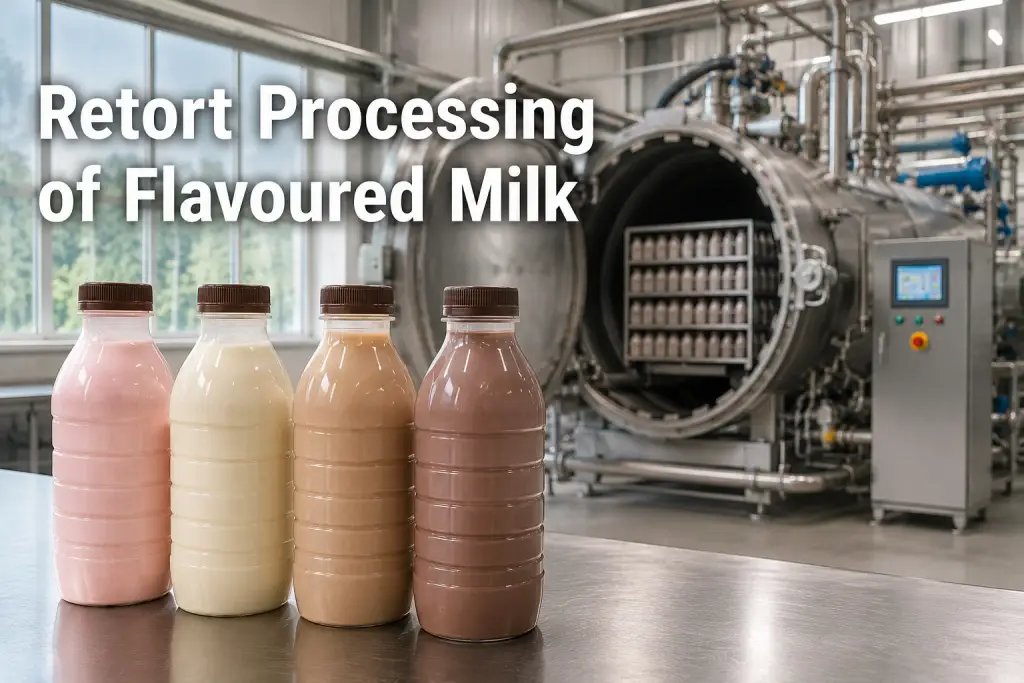
Selection of a suitable package is one of the most important decisions in process development.
Common options include:
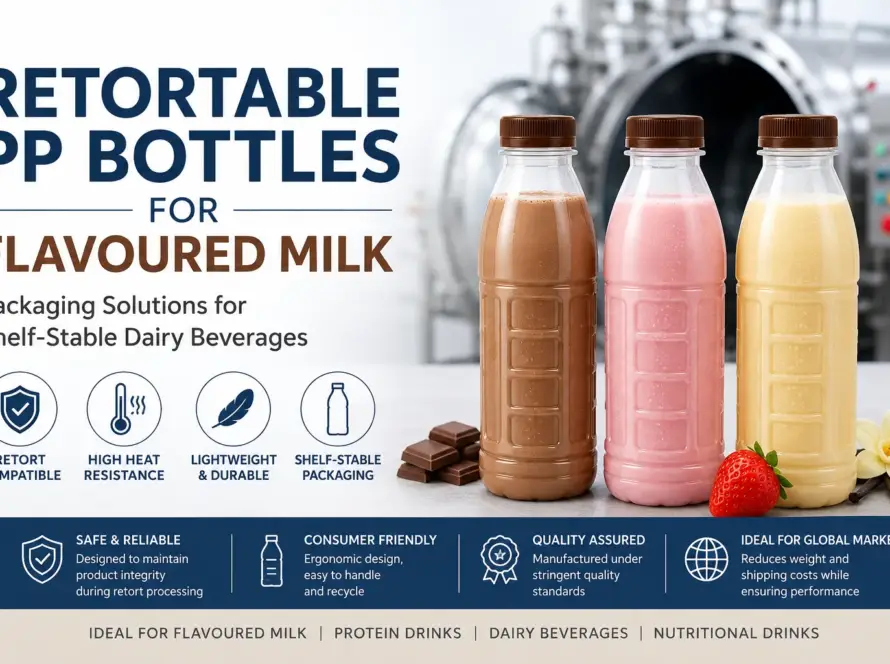
Retortable PP Bottles
Polypropylene bottles are increasingly used due to their heat resistance, lightweight nature, and consumer convenience.
Glass Bottles
Glass provides excellent barrier properties but increases transportation costs and breakage risks.
Flexible Retort Pouches
Pouches offer rapid heat penetration and reduced packaging weight.
Specialty Retort Containers
Certain multilayer plastic containers and trays are designed specifically for thermal processing applications.
Packaging materials must withstand thermal processing conditions without deformation, seal failure, or loss of integrity.
Understanding Commercial Sterility – Retort Processing of Flavoured Milk
Commercial sterility is the primary objective of retort processing.
A commercially sterile product is one that has received sufficient thermal treatment to render it free from microorganisms capable of growing under normal non-refrigerated storage conditions.
Commercial sterility is achieved through a scientifically established and validated thermal process.
Key considerations include:
- Product formulation
- Container dimensions
- Heat penetration characteristics
- Process temperature
- Process time
- Cooling procedures
Each product-package combination requires careful evaluation before commercial production.
Thermal process validation often involves understanding lethality calculations and the role of F₀ values in achieving commercial sterility. Learn more in our article, What is F₀ in Retort Processing? (https://potandladle.com/what-is-f0-in-retort-processing/)
Retort Systems Used for Dairy Beverages – Retort Processing of Flavoured Milk
Several retort technologies may be used for flavoured milk production.
Water Spray Retorts
Widely used for plastic bottles and containers requiring uniform heat transfer.
Water Immersion Retorts
Provide excellent temperature uniformity and package protection.
Steam-Air Retorts
Suitable for products requiring controlled pressure environments.
Selection depends on package type, production capacity, and product characteristics.
Key Considerations in Retort Processing of Flavoured Milk
| Area | Key Consideration |
|---|---|
| Formulation | Protein stability and flavour retention |
| Homogenization | Prevention of fat separation |
| Packaging | Retort resistance and closure integrity |
| Filling | Consistent headspace control |
| Thermal Processing | Achievement of commercial sterility |
| Cooling | Prevention of package deformation |
| Validation | Heat penetration and process verification |
| Quality Control | Sensory and microbiological evaluation |
Common Challenges in Retort Processing of Flavoured Milk
Protein Instability
Milk proteins can undergo changes during thermal processing, affecting texture and appearance.
Fat Separation
Inadequate homogenization may result in cream layer formation.
Sedimentation
Cocoa particles and other suspended ingredients may settle during storage.
Flavour Changes
High thermal exposure can alter flavour profiles.
Browning Reactions
Maillard reactions may contribute to colour and flavour changes during processing and storage.
Package Deformation
Improper pressure management can lead to bottle distortion or paneling.
Practical Considerations from a Retort Consultant
In practical dairy retort projects, package performance is often as critical as the thermal process itself. A retort process that achieves commercial sterility may still fail commercially if bottle deformation, cap leakage, flavour degradation, or sedimentation issues are not properly addressed during product development and validation.
Bottle Deformation
Retortable PP bottles are subjected to elevated temperatures and pressures during thermal processing. Improper package selection, inadequate pressure control, or excessive vacuum development during cooling can result in bottle paneling, distortion, or dimensional changes. Manufacturers should evaluate bottle performance under actual processing conditions to ensure package integrity and consumer acceptance.
Headspace Control
Consistent headspace is critical for successful retort processing. Excessive headspace may affect heat transfer and package appearance, while insufficient headspace can increase internal pressure during processing and potentially compromise container integrity. Maintaining controlled fill volumes and headspace levels helps ensure consistent processing and package performance.
Protein Fouling
Milk proteins are sensitive to heat and can deposit on processing equipment surfaces during manufacturing. Protein fouling may reduce heat transfer efficiency, affect equipment performance, and increase cleaning requirements. Proper formulation, process design, and cleaning procedures are essential for maintaining operational efficiency and product quality.
Cocoa Sedimentation
Chocolate-flavoured milk and cocoa-based dairy beverages can experience particle settling during storage. Factors such as particle size, formulation, homogenization efficiency, and stabilizer selection influence sedimentation behaviour. Product developers should conduct shelf-life studies to ensure acceptable product appearance and consistency throughout the intended shelf life.
Closure Performance
Container closures play a critical role in maintaining commercial sterility. Caps, seals, and closure systems must withstand thermal processing conditions without leakage, deformation, or loss of sealing integrity. Closure performance should be verified through appropriate validation and package integrity testing before commercial production.
Consultant’s Perspective
In practical dairy retort projects, package performance is often just as important as thermal process design. A retort process may successfully achieve commercial sterility, yet the product can still face market challenges if issues such as bottle deformation, cap leakage, flavour degradation, sedimentation, or poor appearance are not adequately addressed during product development and validation. Successful shelf-stable flavoured milk products require a balanced approach to formulation, packaging, processing, and quality assurance.
Process Validation and Food Safety – Retort Processing of Flavoured Milk
Developing a retort process involves more than selecting a temperature and process time.
Validation activities may include:
- Temperature distribution studies
- Heat penetration studies
- Container integrity evaluations
- Process establishment
- Documentation and recordkeeping
A scientifically developed process helps ensure both food safety and product quality.
For low-acid dairy beverages, process development should be performed by qualified thermal processing professionals with expertise in commercial sterilization principles.
Regulatory Considerations – Retort Processing of Flavoured Milk
Manufacturers should ensure compliance with applicable food safety regulations, standards, and customer requirements.
Areas of focus include:
- Good Manufacturing Practices (GMP)
- Hygienic design
- Process monitoring
- Calibration programs
- Container closure integrity
- Thermal process documentation
Regulatory expectations may differ between domestic and export markets.
Future Opportunities for Shelf-Stable Dairy Beverages
Growing consumer demand for convenience, nutrition, and portability is creating new opportunities in:
- High-protein dairy drinks
- Functional milk beverages
- Fortified flavoured milk
- Sports nutrition beverages
- Children’s nutrition products
Retort technology continues to play a vital role in enabling ambient distribution of these products while maintaining safety and product stability.
Manufacturers considering shelf-stable dairy beverages may also be interested in the broader business aspects of commercializing retort-processed products. Read our guide, Launching a Retort Food Brand: A Practical Guide (https://potandladle.com/launching-a-retort-food-brand/)
Frequently Asked Questions (FAQs)
What is Retort Processing of Flavoured Milk?
Retort Processing of Flavoured Milk is a thermal processing method in which flavoured milk is filled into retortable containers, hermetically sealed, and subjected to a validated heat treatment to achieve commercial sterility and extended shelf life at ambient temperatures.
Can flavoured milk be stored without refrigeration?
Yes. Properly formulated, packaged, and retort-processed flavoured milk can be stored at ambient temperatures without refrigeration while maintaining safety and quality throughout its intended shelf life.
Why is homogenization important in flavoured milk production?
Homogenization reduces the size of fat globules, improves emulsion stability, enhances mouthfeel, and helps prevent cream separation during storage. It is a critical step in producing a consistent and stable dairy beverage.
What packaging materials are used for retort-processed flavoured milk?
Common packaging options include retortable polypropylene (PP) bottles, glass bottles, and certain specialty retort containers. The selected package must withstand thermal processing conditions while maintaining container integrity and product safety.
What is commercial sterility in flavoured milk?
Commercial sterility refers to the condition achieved when a product has received sufficient thermal treatment to eliminate microorganisms capable of growing under normal non-refrigerated storage conditions. It is the primary objective of retort processing.
What are the main challenges in Retort Processing of Flavoured Milk?
Common challenges include protein instability, fat separation, flavour changes, sedimentation of cocoa or other ingredients, bottle deformation, and maintaining container closure integrity during thermal processing.
What types of retorts are used for flavoured milk processing?
Water spray retorts, water immersion retorts, and steam-air retorts are commonly used depending on the packaging format, product characteristics, and production requirements.
Are PP bottles suitable for retort processing?
Yes. Retort-grade polypropylene (PP) bottles are widely used for shelf-stable dairy beverages because they can withstand elevated temperatures and pressures encountered during commercial sterilization.
How is a retort process validated for flavoured milk?
Process validation typically involves temperature distribution studies, heat penetration studies, container integrity assessments, and the establishment of a scientifically validated thermal process to ensure product safety and quality.
What is the difference between pasteurized and retort-processed flavoured milk?
Pasteurized flavoured milk requires refrigerated storage and has a shorter shelf life, whereas retort-processed flavoured milk is commercially sterile and can typically be stored at ambient temperatures for extended periods.
Conclusion
Retort processing is a proven technology for manufacturing shelf-stable flavoured milk and other dairy beverages. Successful commercialization depends on the integration of formulation development, homogenization, package selection, thermal process validation, and food safety management.
As consumer demand for ambient dairy products continues to grow, manufacturers who invest in scientifically validated retort processes can benefit from expanded distribution, improved shelf life, and enhanced market opportunities.
Manufacturers should ensure that thermal processes comply with applicable food safety requirements and commercial sterility principles outlined by the U.S. FDA Low-Acid Canned Foods (LACF) Program
About the Author
Karthikeyan is a Retort Food Processing & Commercial Sterilization Consultant and Better Process Control School (BPCS) Certified professional specializing in thermal processing, retort technology, shelf-stable food development, and regulatory compliance for low-acid canned foods (LACF) and acidified foods. Through Pot & Ladle, he shares practical insights on retort processing, food safety, packaging technologies, and commercial sterilization for food manufacturers worldwide.


1 Comment
Comments are closed.