


Retortable PP Bottles for Flavoured Milk play a critical role in the production of shelf-stable dairy beverages intended for ambient storage and distribution. Lightweight, durable, and capable of withstanding thermal processing conditions, retortable PP bottles have become a preferred packaging option for flavoured milk and other ambient dairy products.
Unlike conventional beverage bottles, retortable PP bottles must withstand elevated temperatures, pressure fluctuations, and cooling cycles during commercial sterilization while maintaining container integrity and product quality. Successful commercialization therefore depends not only on the thermal process but also on careful package selection, validation, and performance testing.
This article is intended for dairy beverage manufacturers, food entrepreneurs, packaging suppliers, contract manufacturers, food technologists, and professionals involved in shelf-stable beverage development.
Key Characteristics of Retortable PP Bottles
| Parameter | Description |
|---|---|
| Material | Polypropylene (PP) |
| Application | Shelf-Stable Dairy Beverages |
| Processing Method | Retort Sterilization |
| Key Benefit | Heat Resistance |
| Common Formats | Bottles and Containers |
| Primary Concern | Container Integrity |
| Typical Challenges | Paneling, Deformation, Leakage |
Key Takeaways
- Retortable PP bottles are widely used for shelf-stable flavoured milk.
- Packaging performance is critical to commercial success.
- Bottle design and closure selection influence retort performance.
- Validation should include package integrity and shelf-life testing.
- Commercial sterility and package stability must be achieved simultaneously.
Why Use PP Bottles for Flavoured Milk?
Retortable PP bottles offer several advantages for dairy beverage manufacturers.
Lightweight Construction
Compared to glass bottles, PP bottles significantly reduce packaging weight and transportation costs.
Consumer Convenience
PP bottles are easy to handle, portable, and suitable for on-the-go consumption.
Shatter Resistance
Unlike glass, polypropylene bottles are resistant to breakage during transportation and distribution.
Cost Efficiency
Reduced logistics costs and easier handling make PP bottles an attractive packaging option for shelf-stable dairy beverages.
Retort Compatibility
Retort-grade PP bottles are specifically designed to withstand commercial sterilization conditions while maintaining package integrity.
Retortable PP Bottles vs Glass Bottles
| Factor | Retortable PP Bottles | Glass Bottles |
|---|---|---|
| Weight | Low | High |
| Breakage Risk | Low | High |
| Transport Cost | Lower | Higher |
| Consumer Convenience | High | Moderate |
| Retort Compatibility | Excellent | Excellent |
| Appearance | Modern | Premium |
Understanding Retortable Polypropylene (PP)
Polypropylene is a thermoplastic polymer widely used in food packaging applications. Retort-grade PP bottles are engineered to withstand the elevated temperatures and pressures encountered during thermal processing.
Key characteristics include:
- Good heat resistance
- Excellent chemical resistance
- Lightweight construction
- Food-contact suitability
- Recyclability potential
It is important to recognize that not all PP bottles are suitable for retort processing. Containers intended for thermal processing are typically designed with specific structural features to withstand commercial sterilization conditions.
Typical Packaging System Components – Retortable PP Bottles for Flavoured Milk
A retortable dairy beverage package consists of several integrated components:
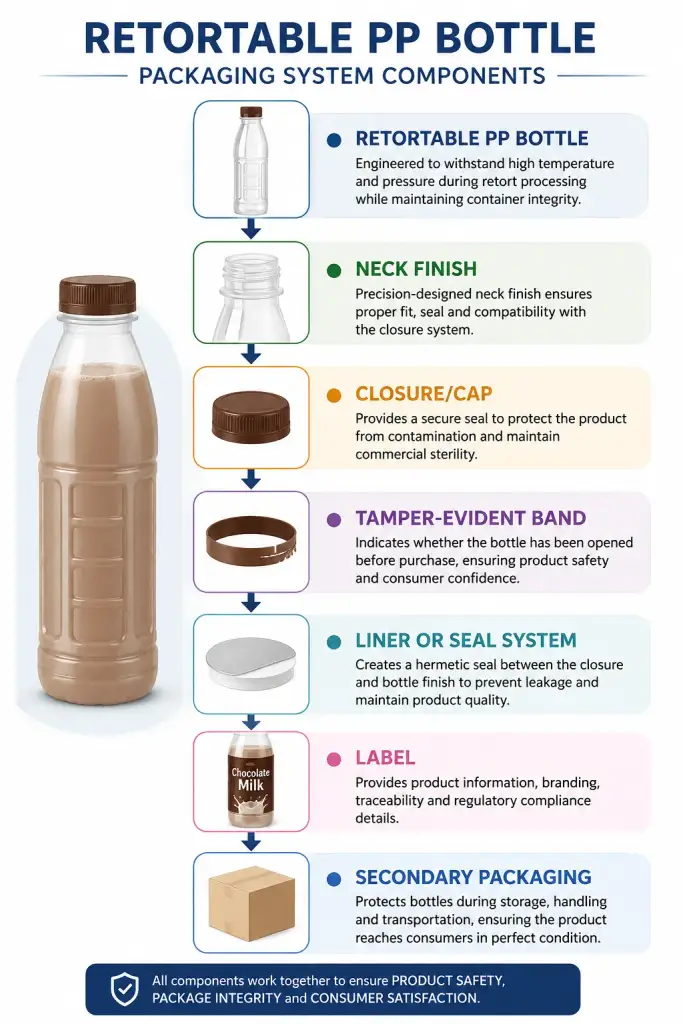
Each component contributes to package integrity and product safety. Failure of any component may compromise product quality or commercial sterility.
Critical Bottle Design Considerations – Retortable PP Bottles for Flavoured Milk
Many product developers focus on retort parameters while underestimating the importance of bottle design.
Wall Thickness
Bottle walls must provide adequate structural support during heating and cooling cycles.
Bottle Geometry
Shape influences pressure distribution and package stability during processing.
Vacuum Panel Design
Vacuum panels help accommodate pressure changes that occur during cooling.
Neck Strength
The neck area must maintain dimensional stability to support proper closure performance.
Base Stability
Bottle bottoms should remain stable throughout processing and storage.
Key Considerations – Retortable PP Bottles for Flavoured Milk
| Area | Key Consideration |
|---|---|
| Bottle Design | Structural stability |
| Closure System | Seal integrity |
| Filling | Headspace control |
| Retort Process | Pressure management |
| Cooling | Vacuum control |
| Validation | Package performance testing |
| Shelf Life | Long-term stability |
Closure and Seal Performance – Retortable PP Bottles for Flavoured Milk
Closures play a critical role in maintaining commercial sterility.
Factors influencing closure performance include:
- Cap design
- Application torque
- Seal materials
- Thermal expansion characteristics
- Pressure resistance
Closure systems should be evaluated under actual processing conditions to ensure long-term package integrity.
Container Closure Integrity – Retortable PP Bottles for Flavoured Milk
Container closure integrity testing helps verify that the package remains hermetically sealed throughout processing, storage, and distribution.
Retortable PP bottles are only one component of a successful shelf-stable dairy beverage. Their performance is closely linked to product formulation, homogenization, thermal processing, and commercial sterility requirements. For a broader understanding of how shelf-stable dairy beverages are manufactured and validated, read our article on Retort Processing of Flavoured Milk: A Practical Guide to Shelf-Stable Dairy Beverages.
Validation and Package Testing Considerations – Retortable PP Bottles for Flavoured Milk
Retortable PP bottle validation should extend beyond simple visual inspection.
Typical evaluations may include:
Retort Trials
Verification of package performance under actual thermal processing conditions.
Cooling Evaluations
Assessment of bottle deformation and vacuum development during cooling.
Transportation Testing
Evaluation of package durability during handling and distribution.
Shelf-Life Studies
Monitoring package stability throughout the intended storage period.
Container Integrity Testing
Verification that the package remains hermetically sealed following processing.
Proper thermal process development and validation are essential for safe shelf-stable foods. FDA inspection guidance highlights the importance of scheduled processes, heat penetration studies, and process authority involvement for thermally processed foods. FDA Guidance on Scheduled Processes and Thermal Processing
Practical Validation Example from a Retort Project
During the validation of a shelf-stable flavoured milk project, retortable PP bottles were evaluated alongside thermal processing parameters to assess overall package performance. In addition to achieving commercial sterility, the validation program focused on bottle deformation, closure integrity, headspace control, and package appearance following retort processing. Multiple production-scale trials were conducted to confirm that the selected bottle and closure system could withstand heating, pressure changes, cooling, storage, and distribution conditions. This type of integrated evaluation helps manufacturers identify potential packaging issues before commercial launch.
Common Challenges – Retortable PP Bottles for Flavoured Milk
Several packaging-related issues may arise during commercialization.
Bottle Deformation
Improper pressure control or unsuitable bottle design may result in package distortion.
Paneling
Excessive vacuum development can cause inward collapse of bottle walls.
Cap Leakage
Inadequate closure performance may compromise package integrity.
Stress Cracking
Mechanical and thermal stresses may affect long-term package performance.
Label Distortion
Labels must withstand processing temperatures and moisture exposure.
Excessive Vacuum Formation
Improper cooling conditions may adversely affect package appearance.
Practical Considerations from a Retort Consultant – Retortable PP Bottles for Flavoured Milk
In practical dairy retort projects, package performance is often as critical as the thermal process itself. A retort process that achieves commercial sterility may still fail commercially if bottle deformation, cap leakage, flavour degradation, or package appearance issues are not properly addressed during product development and validation.
Headspace Management
Proper headspace control is essential for package performance and process consistency.
Bottle Orientation
Container positioning may influence package behavior during thermal processing.
Retort Basket Loading
Overloading or improper basket configuration may affect heat transfer and package stability.
Cooling Control
Pressure management during cooling is often critical for preventing package deformation.
Bottle and Closure Compatibility
A high-performance bottle cannot compensate for an inadequate closure system. Both components should be evaluated together during validation.
Regulatory and Food Safety Considerations – Retortable PP Bottles for Flavoured Milk
Manufacturers should ensure compliance with applicable food safety and packaging regulations.
Important considerations include:
- Food-contact compliance
- Commercial sterility requirements
- Container integrity verification
- Good Manufacturing Practices (GMP)
- Validation documentation
For low-acid dairy beverages, thermal processes should be developed and validated using sound scientific principles and appropriate technical expertise.
Manufacturers developing shelf-stable dairy beverages should understand the regulatory principles governing thermally processed low-acid foods packaged in hermetically sealed containers. The U.S. FDA provides guidance on low-acid canned foods (LACF), process filing, and commercial sterilization requirements. FDA Low-Acid Canned Foods Guidance
Future Trends in Dairy Beverage Packaging – Retortable PP Bottles for Flavoured Milk
The dairy beverage sector continues to evolve with increasing emphasis on:
- Lightweight bottle designs
- Sustainable packaging solutions
- Improved recyclability
- Enhanced retort performance
- Premium shelf-stable dairy products
Demand for ambient dairy beverages is expected to drive continued innovation in retortable packaging technologies.
Frequently Asked Questions (FAQs) – Retortable PP Bottles for Flavoured Milk
What are retortable PP bottles?
Retortable PP bottles are polypropylene containers specifically designed to withstand the temperatures and pressures encountered during commercial sterilization and retort processing.
Can PP bottles withstand retort processing?
Yes. Retort-grade polypropylene bottles are engineered to tolerate thermal processing conditions while maintaining package integrity and product safety.
Why do PP bottles deform during retort processing?
Bottle deformation may result from inadequate package design, improper pressure management, excessive vacuum formation, or incompatibility between the bottle and closure system.
Are PP bottles better than glass for flavoured milk?
Both materials have advantages. PP bottles offer reduced weight, improved impact resistance, and lower transportation costs, while glass provides excellent barrier properties and premium appearance.
How are retortable PP bottles validated?
Validation typically includes retort trials, cooling evaluations, package integrity testing, transportation assessments, and shelf-life studies.
What causes cap leakage after retort processing?
Cap leakage may occur due to improper torque application, seal failure, dimensional changes, or incompatibility between the closure and bottle finish.
Can retortable PP bottles be used for protein drinks?
Yes. Retortable PP bottles are commonly used for a variety of shelf-stable dairy beverages, including protein-enriched milk products.
What packaging tests should be performed before commercialization?
Manufacturers commonly perform container integrity testing, retort validation, transportation studies, shelf-life evaluations, and closure performance assessments.
Conclusion
Retortable PP bottles play a critical role in the successful commercialization of shelf-stable flavoured milk and other ambient dairy beverages. While thermal process validation is essential, packaging performance is equally important in ensuring product quality, safety, and consumer acceptance.
Successful projects require careful integration of bottle design, closure selection, process development, validation, and quality assurance. Manufacturers that invest in comprehensive package evaluation can significantly improve the likelihood of long-term commercial success.
Professionals seeking additional technical resources on thermal processing, food safety, and commercial sterilization can explore the educational materials and industry resources provided by the Institute for Thermal Processing Specialists (IFTPS). Institute for Thermal Processing Specialists (IFTPS)
Important: Packaging recommendations and thermal processing requirements vary by product, container design, and manufacturing conditions. Package validation and process development should be performed using appropriate technical expertise and product-specific testing.
About the Author
Karthikeyan is a Retort Food Processing & Commercial Sterilization Consultant and Better Process Control School (BPCS) Certified professional specializing in thermal processing, retort technology, shelf-stable food development, packaging validation, and regulatory compliance for low-acid and acidified foods. Through Pot & Ladle, he shares practical insights on retort processing, commercial sterilization, food packaging technologies, and product commercialization.

1 Comment
Comments are closed.