High-quality Preservative-Free Wet Dog Food processed using commercial retort thermal sterilization represents the next major technological leap in pet nutrition. As pet owners increasingly view companion animals as family members, demand has surged for high-moisture, meat-first diets that eliminate synthetic chemical preservatives like BHA, BHT, ethoxyquin, and potassium sorbate.
However, traditional fresh wet pet foods create severe supply chain bottlenecks: they demand continuous cold-chain logistics, refrigerated transport, and offer a very limited shelf life once thawed.
Pot & Ladle, based in Chennai, Tamil Nadu, India, bridges this critical industrial gap. Utilizing commercial Retort Sterilization Technology paired with nutrient-dense Mechanically Deboned Meat (MDM), Pot & Ladle manufactures 100% Preservative-Free Wet Dog Food that achieves a 24-month ambient shelf life without requiring refrigeration or synthetic additives.
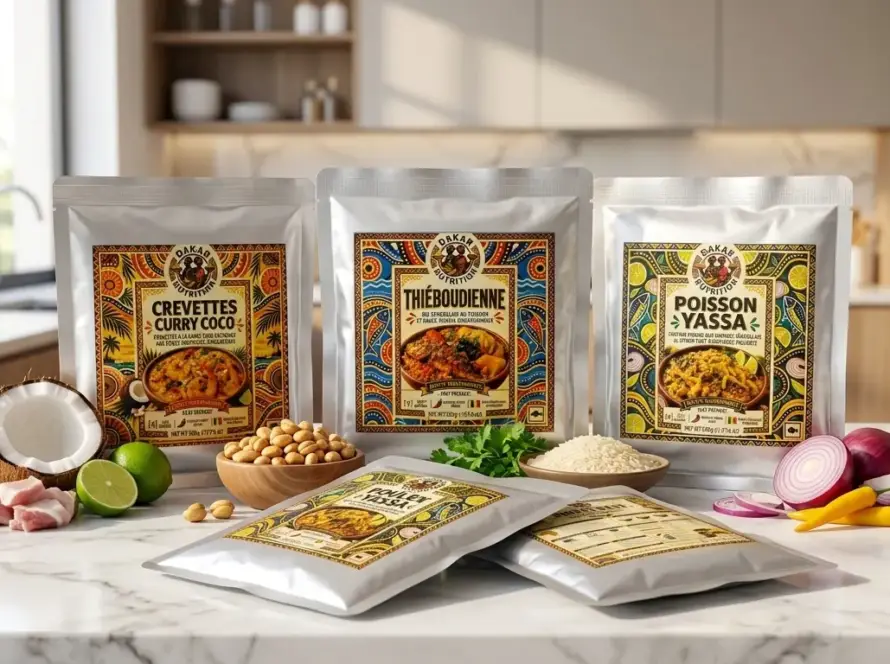
Retort technology has transformed the commercial pet food sector by introducing industrial sterilization protocols that guarantee absolute microbiological safety without relying on artificial chemical preservatives. Operating much like a massive commercial pressure cooker, modern retort systems subject hermetically sealed multi-layer pouches or metal containers to precise thermal profiles—typically ranging from 121°C to 125°C under high overpressure. This critical process targets and destroys heat-resistant spores like Clostridium botulinum, accumulating a validated $F_0$ lethality value that achieves a 12-to-24-month ambient shelf life without the need for constant cold-chain refrigeration. For a comprehensive look at how thermal sterilization packages and processes commercial-grade pet food, you can review the technical insights on Retort Packaging for Wet Pet Food.
Maintaining compliance in retort-processed pet food manufacturing also requires close adherence to national food governance and standardized processing guidelines. In India, producers navigate oversight intersecting general food safety rules and specialized animal nutrition codes, such as the voluntary specifications outlined in the Bureau of Indian Standards catalogue under IS 11968:2019 Pet Food Guidelines and safety enforcement structures governed by the FSSAI Official Portal. By aligning formulation and thermal lethality validations with these standards, manufacturers ensure that high-moisture meat bases remain safe, shelf-stable, and nutritionally reliable for modern pet consumers.
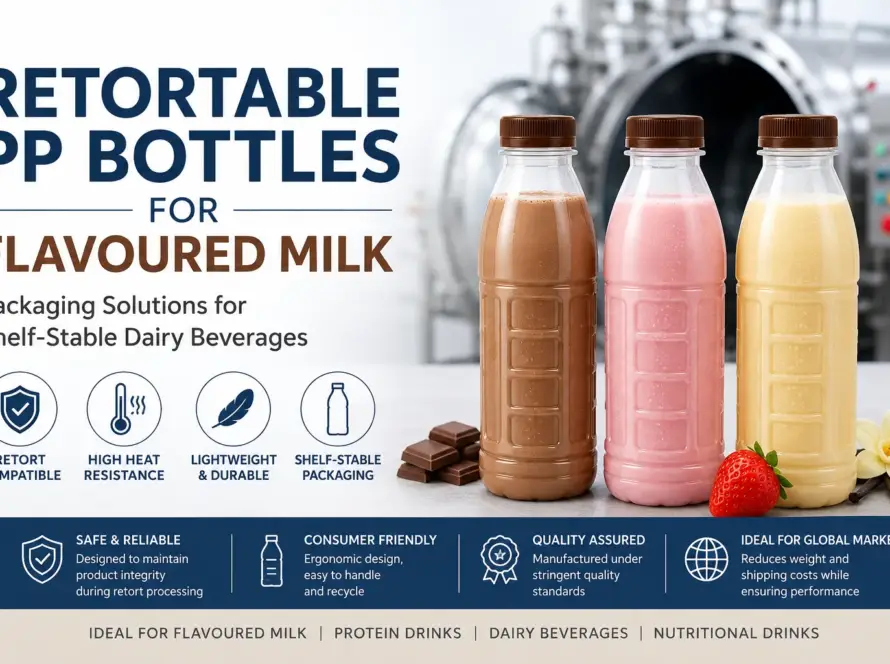
While retort processing technology shares foundational thermodynamic principles across industries—whether sterilizing high-moisture meat proteins for pet food or shelf-stable dairy products—manufacturers exploring parallel container formats can review the specific material selection, thermal validation, and processing parameters outlined in the Pot & Ladle guide on Retortable PP Bottles for Flavoured Milk: Selection, Validation and Processing Considerations.
This comprehensive technical guide explores the biophysics of thermal sterilization, the nutritional chemistry of MDM meat, formulation strategies, regulatory frameworks (including Indian BIS IS 11968:2019 and FSSAI guidelines), and custom private-label manufacturing operations.
The Physics & Engineering of Retort Thermal Sterilization
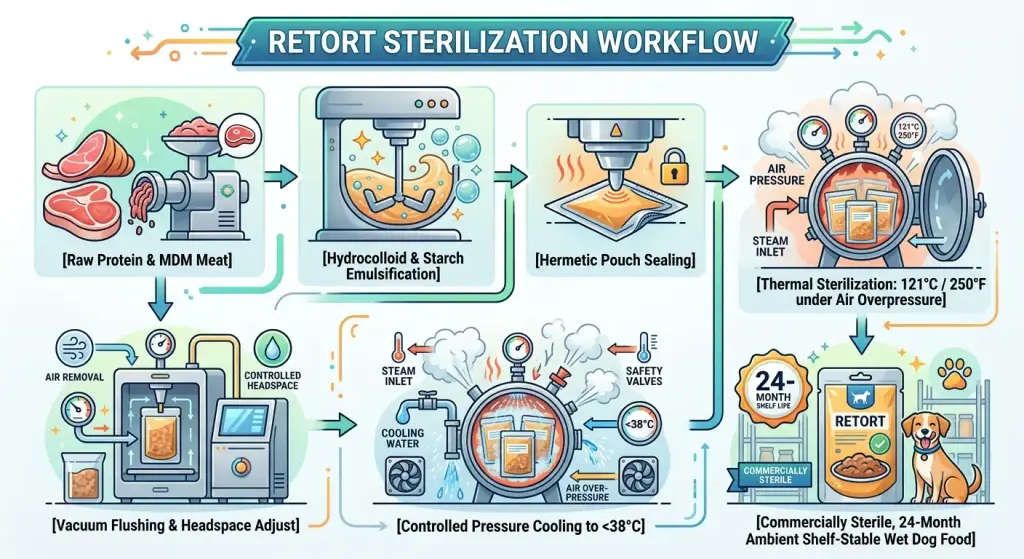
Retort processing is an advanced thermal sterilization method where pre-formulated food is hermetically sealed within high-barrier flexible packaging (pouches, rigid trays, or cans) and subjected to controlled heat and overpressure inside a pressure vessel (a retort).
Achieving Commercial Sterility Without Chemical Preservatives
In conventional pet foods, chemical preservatives are required to retard mold growth, lipid oxidation, and bacterial proliferation. Retort processing eliminates this necessity entirely through thermal lethality.
The target of commercial sterilization in low-acid foods (defined as foods with a $\text{pH} > 4.6$ and water activity $a_w > 0.85$, which includes all wet dog foods) is the destruction of Clostridium botulinum spores.
- Thermal Death Time ($D$-value): The time required at a specific temperature (typically $121.1^\circ\text{C}$ or $250^\circ\text{F}$) to reduce a microbial population by $90\%$ (1 log cycle). For C. botulinum, $D_{121} \approx 0.21\text{ minutes}$.
- The $12\text{D}$ Concept: Thermal sterilization process calculation demands a minimum $12\text{D}$ log reduction of C. botulinum spores, reducing a theoretical population of $10^{12}$ spores down to $10^0$ (1 spore).
- Target Lethality ($F_0$ Value): $F_0$ represents the equivalent time in minutes at $121.1^\circ\text{C}$ ($250^\circ\text{F}$) delivered to the coldest point (cold spot) inside the container.
$$\text{Target } F_0 = D_{121} \times 12 = 0.21 \times 12 = 2.52\text{ minutes}$$
To ensure an adequate safety margin across variable product viscosities and line speeds, Pot & Ladle operates at target $F_0$ values between $3.5$ and $6.0$ minutes, rendering the product 100% commercially sterile and biologically stable at ambient tropical temperatures.
Overpressure Control & Packaging Mechanics
Because wet pet food contains water, heating it above boiling point ($100^\circ\text{C}$) generates internal steam pressure within the sealed pouch. Without counter-balancing external pressure, flexible pouches will burst, or seal layers will suffer micro-fractures (delamination).
Pot & Ladle utilizes Air Overpressure Water Spray / Steam Retorts. Compressed air is injected during the heating and cooling phases to equalize external pressure with the internal expansion pressure of the pouch, preserving package integrity and hermetic seals.
Mechanically Deboned Meat (MDM) – Nutritional Chemistry & Functionality
The foundational protein engine in Pot & Ladle’s customized formulas is Mechanically Deboned Meat (MDM).
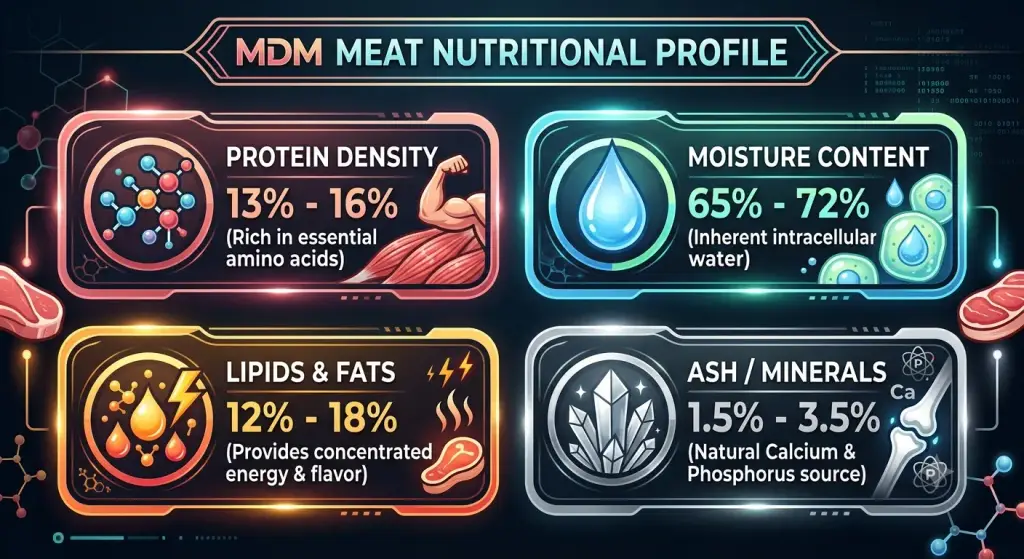
How MDM Meat is Produced
MDM is derived by passing poultry, pork, or beef skeletal frames—after primary muscle cuts are removed—through continuous high-pressure mechanical deboners or screen separators. The machinery forces soft muscle tissue, intermuscular fat, and soft cartilage through micro-perforated screens while excluding hard structural bones. The output is a uniform, highly emulsifiable meat paste.
Functional Advantages of MDM in Retort Pet Foods
- Superior Emulsification Capacity: MDM contains soluble sarcoplasmic and myofibrillar proteins that encapsulate free fat droplets during high-shear mixing, preventing fat separation (oil bleeding) during retort thermal cycles.
- Enhanced Bioavailability: The fine particle size of MDM maximizes the surface area exposed to canine digestive enzymes (pepsin and trypsin), delivering rapid amino acid absorption.
- Natural Palatability Matrix: The presence of natural bone marrow lipids within MDM releases volatile aromatic compounds during thermal cooking, creating a flavor profile that appeals to dogs without artificial palatants.
- Endogenous Glucosamine & Chondroitin: Microscopic cartilage fractions retained in MDM provide natural joint-supporting glycosaminoglycans.
Comprehensive Formulation & Nutrient Matrix – Preservative-Free Wet Dog Food
A successful retort wet dog food requires balancing raw protein, complex carbohydrates, healthy fats, functional fibers, and thermal-stabilizing hydrocolloids.
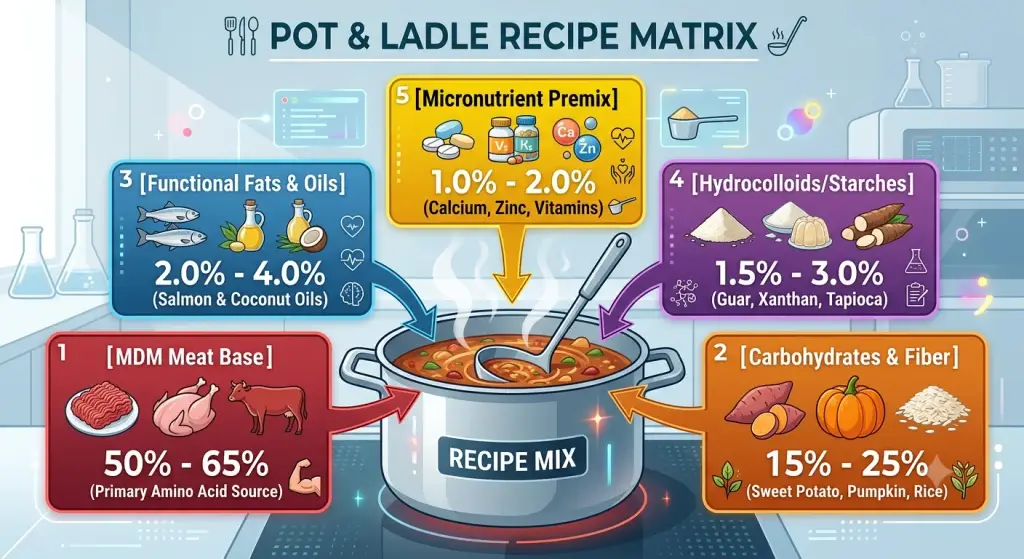
Ingredient Functionality Table – Preservative-Free Wet Dog Food
| Ingredient Category | Primary Sources | Functional Purpose in Formulation | Thermal & Biological Stability |
| Primary Protein | Chicken MDM, Turkey MDM, Pork MDM, Fish MDM | Muscle synthesis, structural tissue repair, core palatability | Emulsifies fats; coagulates into firm paste/pate during thermal step |
| Carbohydrate Energy | Sweet Potato, Pumpkin, Brown Rice, Rolled Oats | Sustained glycemic energy, digestive fiber, stool firmness | Starch granules gelatinize during retorting, binding free moisture |
| Essential Fatty Acids | Wild Salmon Oil, Cold-Pressed Coconut Oil | Omega-3 (EPA/DHA) & Omega-6; skin barrier health, shiny coat | Protected from atmospheric oxidation inside hermetically sealed vacuum pouches |
| Vegetable Fiber | Carrots, Green Beans, Spinach, Peas | Prebiotic fiber (FOS), natural beta-carotene, micronutrient support | Provides visual color contrast and structural texture in pate |
| Hydrocolloid Binders | Guar Gum, Xanthan Gum, Modified Tapioca Starch | Viscosity management, water binding, preventing synergy/purge | Retains structural viscosity up to $121^\circ\text{C}$; prevents phase separation |
| Mineral Balancers | Calcium Carbonate, Purified Eggshell Powder | Offsets high phosphorus in MDM; balances Calcium-to-Phosphorus ($Ca:P$) ratio | Heat-stable inorganic mineral source; maintains target $1.2:1$ ratio |
| Thermostable Premix | Vet-Approved Vitamin B Complex, Zinc, Iodine, Selenium | Replenishes thermal loss of heat-sensitive vitamins (Thiamine/B1) | Formulated with $+20\%$ to $+30\%$ overages to compensate for thermal decay |
Target Applications & Clinical Contraindications – Preservative-Free Wet Dog Food
While retort-processed MDM wet dog food is an ideal nutrient delivery system for the vast majority of domestic canines, clear nutritional boundaries must be established.
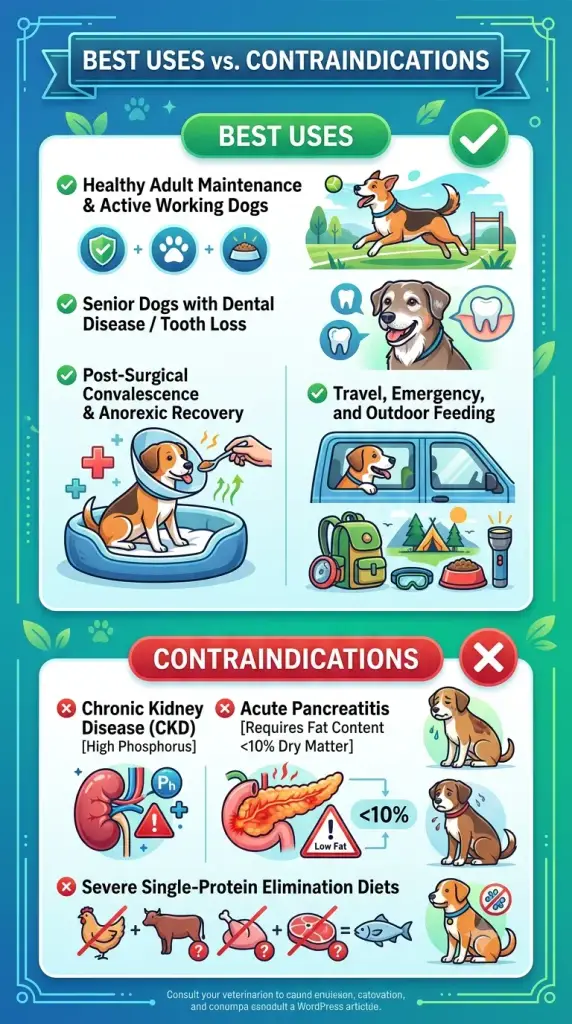
Optimal Use Cases – Preservative-Free Wet Dog Food
- Senior Canine Geriatrics: Older dogs with periodontal disease, reduced bite force, or missing teeth thrive on the soft, smooth pate texture. High moisture ($>75\%$) helps counteract chronic low-level dehydration common in older dogs.
- Veterinary Convalescence: The high aromatic profile of warm MDM wet food stimulates appetite in post-surgical dogs or those recovering from illness.
- Picky Eaters & Kibble Topping: Adding a tablespoon of nutrient-dense MDM pate to dry kibble dramatically increases palatability through natural lipid aromatics.
Clinical Contraindications – Preservative-Free Wet Dog Food
- Chronic Kidney Disease (CKD): MDM naturally contains higher levels of soft bone cartilage, yielding elevated phosphorus levels. Dogs with renal insufficiency require strict dietary phosphorus restriction ($\le 0.4\%$ Dry Matter).
- Acute Pancreatitis: Standard MDM formulations contain moderate-to-high fat levels ($12\%\text{ to }18\%$). Pancreatitis-prone breeds (e.g., Miniature Schnauzers) require low-fat custom diets ($<10\%$ Dry Matter fat).
- Severe Multi-Protein Food Allergies: Unless processed on a dedicated single-species line, MDM can carry trace cross-contact proteins from poultry or pork frames, rendering it unsuitable for strict elimination diets.
Comparative Analysis – Retort Wet Food vs. Other Diets
| Performance & Operational Metric | Pot & Ladle Retort Wet Pouch | Traditional Canned Pet Food | Extruded Dry Kibble | Frozen Fresh Raw Diet |
| Artificial Preservatives | 0% (100% Preservative-Free) | 0% (Dependent on Can) | Synthetic (BHA/BHT) or Tocopherols | 0% (Requires Freezing) |
| Ambient Shelf Stability | 24 Months | 24–36 Months | 12–18 Months | $< 24$ Hours at Room Temp |
| Cold-Chain Dependency | None | None | None | 100% Dependent (High Cost) |
| Moisture Content | 75% – 78% (Promotes Urinary Health) | 75% – 78% | 8% – 10% (Low Hydration) | 70% – 75% |
| Packaging Carbon Footprint | Low (Lightweight flexible pouch) | High (Heavy metal extraction/can) | Moderate | High (Insulated Styrofoam + Ice) |
| Palatability Index | Extremely High | High | Low to Moderate | High |
| Digestion Coefficient | $> 88\%$ Protein Digestibility | $80\% – 85\%$ | $70\% – 78\%$ | $> 90\%$ |
Quality Assurance, Testing Protocols & Regulatory Compliance
Operating out of Chennai, Tamil Nadu, India, Pot & Ladle operates under strict quality control standards for commercial thermal food processing.
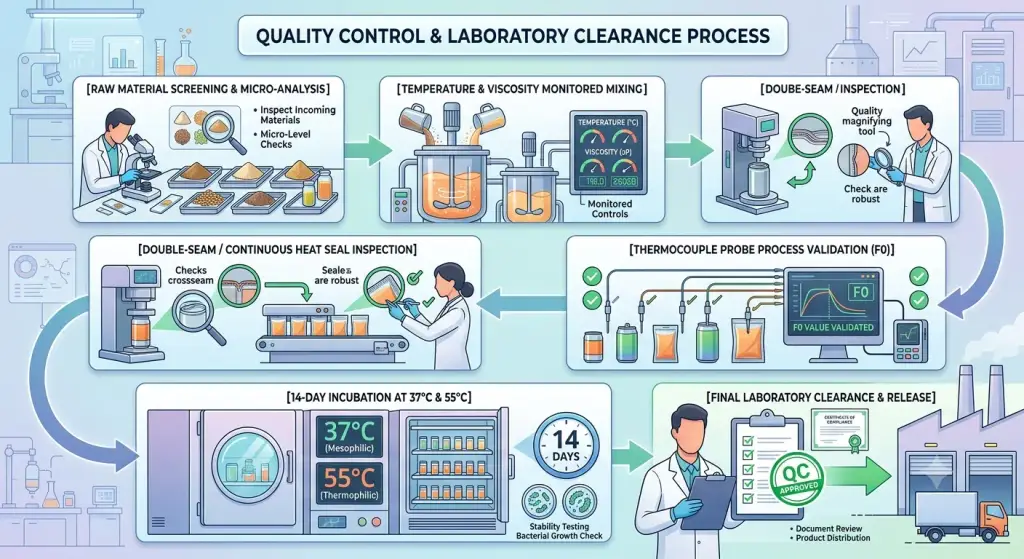
Regulatory Compliance Framework
- FSSAI Alignment: Formulated and processed under Food Safety and Standards Authority of India (FSSAI) licensing standards for commercial food manufacturing facilities.
- BIS IS 11968:2019 Standards: Compliant with the Bureau of Indian Standards (BIS) specifications for Dog and Cat Foods, ensuring nutritional adequacy, heavy metal limits (Arsenic, Lead, Mercury), and microbiological safety.
- BPCS & US FDA LACF Compliance: Designed under Better Process Control School (BPCS) protocols suitable for Low-Acid Canned Food (LACF) registration, enabling international export compliance.
Quality Control & Laboratory Verification – Preservative-Free Wet Dog Food
- Heat Penetration Validation: Wireless thermocouple dataloggers are positioned inside the geometrical center (cold spot) of pouches during test runs to map thermal penetration curves and confirm target $F_0$ lethality.
- Commercial Sterility Incubation: Finished pouches are subjected to a 14-day incubation test at $37^\circ\text{C}$ (mesophilic check) and $55^\circ\text{C}$ (thermophilic check) to confirm zero spore survival.
- Seal Integrity Protocols: Pouch seals undergo automated burst pressure testing ($>2.5\text{ bar}$) and dye penetration testing to detect micro-channel leaks.
- Peroxide Value (PV) & Free Fatty Acids (FFA): Finished products are monitored for lipid stability to guarantee zero rancidity over the 24-month shelf life.
Contract Manufacturing, White Labeling & Private Labeling Solutions – Preservative-Free Wet Dog Food
As the pet food market undergoes a rapid shift toward clean-label, high-moisture diets, emerging pet food brands and established global distributors face significant infrastructure hurdles. Building a commercial retort sterilization facility requires immense capital expenditure, specialized BPCS (Better Process Control School) certified personnel, and strict compliance validation.
Pot & Ladle (Chennai, Tamil Nadu) bridges this operational gap by offering end-to-end contract manufacturing, white labeling, and private labeling partnerships. We empower pet brand owners, veterinary networks, and retail chains to launch and scale their own proprietary lines of Preservative-Free Wet Dog Food without the risks of capital investment in processing plants.
What We Offer Our Private Label Partners:
- Custom Formulation & Recipe Engineering: We collaborate with your brand team to formulate proprietary meat bases (utilizing high-protein Mechanically Deboned Meat), functional fats, starches, and vitamin-mineral premixes tailored to your target life-stage or nutritional claim.
- Retort Pouch & Tray Customization: Flexible packaging solutions ranging from multi-layer high-barrier retort pouches (aluminum foil or transparent high-barrier films) to custom-printed retail packaging featuring your brand identity.
- Strict Quality Assurance & FSSAI/BIS Compliance: Every private label batch is manufactured under rigorous thermal process validation ($F_0 \ge 3.5$), ensuring complete commercial sterility and adherence to Indian BIS standards (IS 11968:2019) and FSSAI guidelines.
- Scalable Production Runs: Flexible minimum order quantities (MOQs) designed to support emerging direct-to-consumer (D2C) pet brands alongside large-scale retail distributors.
Frequently Asked Questions (FAQ) – Preservative-Free Wet Dog Food
Q1: How can dog food stay fresh for 2 years without preservatives or refrigeration?
Answer: Retort technology uses thermal pressure sterilization. Food is sealed inside a multi-layer, high-barrier flexible pouch (which blocks light, oxygen, and moisture). It is then heated to $121^\circ\text{C}$ ($250^\circ\text{F}$) under overpressure, destroying all spoilage bacteria and bacterial spores. Because the sealed environment remains sterile and oxygen-free, the food cannot spoil.
Q2: Is Mechanically Deboned Meat (MDM) safe for dogs?
Answer: Yes, MDM is a safe, highly digestible, and wholesome protein source widely used in global commercial pet foods. It delivers essential amino acids, natural bone marrow lipids, and trace minerals. Pot & Ladle balances all MDM formulations with added calcium to ensure an optimal Calcium-to-Phosphorus ratio ($1.2:1$).
Q3: Does retort heating destroy vitamins in dog food?
Answer: High heat can reduce heat-sensitive vitamins (specifically Thiamine/Vitamin B1). Pot & Ladle accounts for this by over-fortifying raw recipes with vet-approved, heat-stable vitamin and mineral premixes prior to retorting, ensuring the final product meets complete daily nutritional requirements.
Q4: Can Pot & Ladle manufacture custom private-label recipes for pet brands?
Answer: Yes. Pot & Ladle specializes in B2B contract manufacturing, custom formulation, and private labeling. We work with pet brands, veterinary chains, and distributors to develop custom protein mixes, pouch sizes, and specialized functional recipes tailored to target markets.
Q5: How should open retort pet food pouches be handled?
Answer: Unopened pouches can be stored in a standard pantry at room temperature. Once opened, the pouch acts like fresh food: any unused portion must be covered, refrigerated ($<4^\circ\text{C}$), and consumed within 48 hours.
Technical Specifications & Documentation Download
Commercial distributors, pet food brands, and veterinary nutritionists can download full formulation sheets, thermal death time validation reports, and packaging specifications:
[📄 Download Complete Technical Data Sheet & Process Spec (PDF)]
(Includes raw ingredient assays, microbial lethality curves, and packaging pressure tolerance specs)
Contact Pot & Ladle for Custom Orders & B2B Manufacturing
Pot & Ladle partners with pet brands, veterinary clinics, cloud kitchens, and international exporters to develop, scale, and manufacture premium shelf-stable pet foods.
- 🏢 Manufacturing Facility: Chennai, Tamil Nadu, India
Author Profile & Credentials
Karthikeyan V
Retort Food Processing & Commercial Sterilization Consultant
Better Process Control School (BPCS) Certified
Specializing in U.S. FDA Low-Acid Canned Foods (LACF) & Acidified Foods Compliance
Founder: Pot & Ladle RTE Foods, Chennai, Tamil Nadu, India
✉️ Email: potandladlefoods@gmail.com | vk@potandladle.com
📞 Phone: +91 9962 002500